Last week Claude Code quietly shipped cross-session messaging (v2.1.224, on by default). Every session, meaning one open conversation in one terminal tab with its own working memory, can now see the other sessions on the same machine by name and send them messages.
Three things make this bigger than it sounds. Sessions find each other by name and talk asynchronously: no setup, no copy-pasting context between tabs. Only a short summary travels between them, never the full memory, which keeps it cheap; and a peer session cannot approve or escalate anything, which keeps it safe. And all the context trapped in idle tabs becomes reachable. I had 46 idle sessions open. Overnight, they went from 46 separate amnesiacs to an addressable team.
One weekend, one laptop
The morning it landed, at 10:20, I messaged 3 of my 46 idle sessions. Two minutes later: a full status picture, zero tabs opened, and 2 to-dos quietly waiting on me that I would never have found.
The best reply came from a session I messaged by mistake. “Not mine,” it said, then found whose work it was and fixed an error in my tracker, unprompted. They behaved like colleagues, not databases.
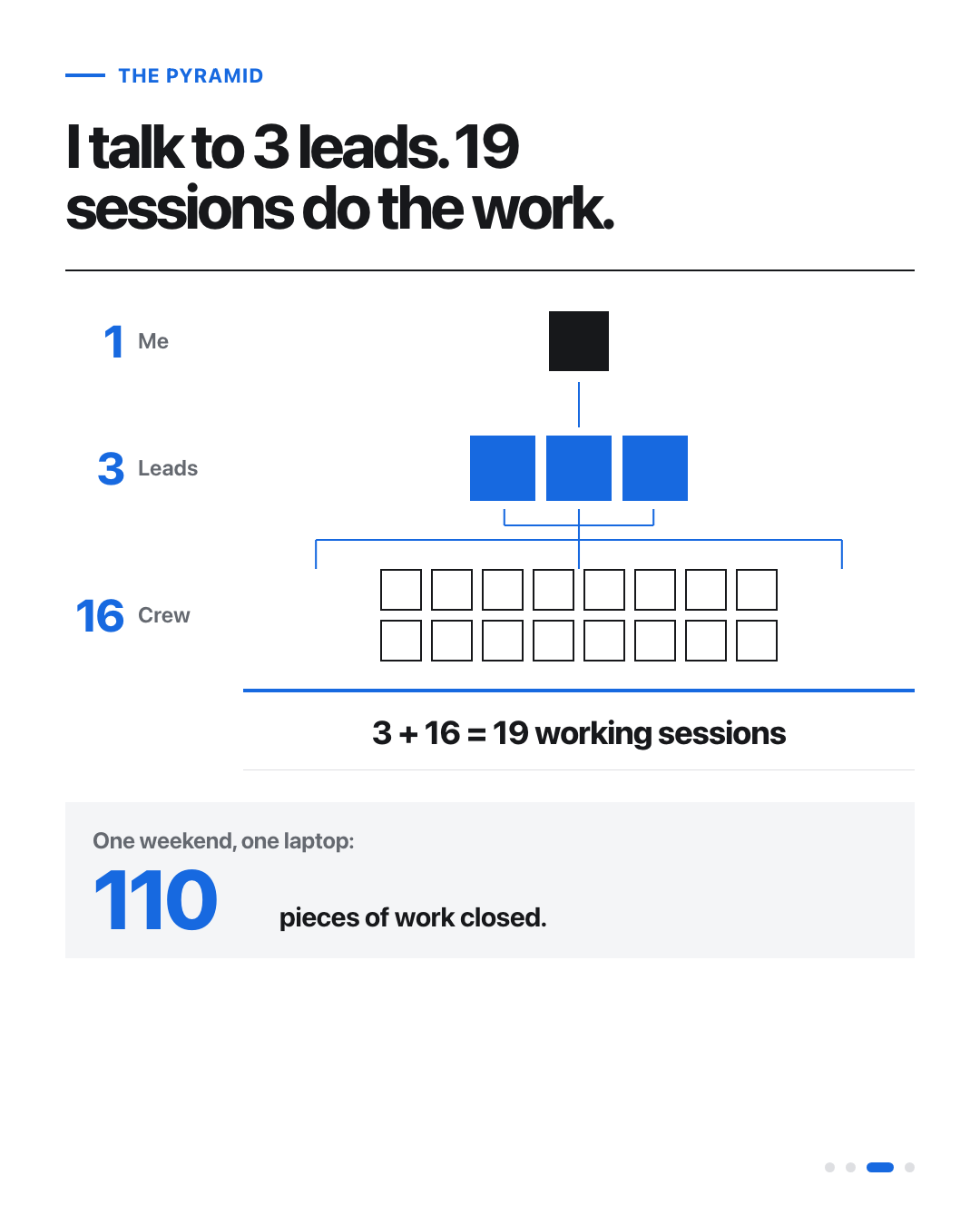
By 11:35 one lead session was running 5 deck builds in parallel; by 9pm it had verified every deck with file hashes and click-tests, closed the program, and released its crew. Over the weekend, 19 sessions closed 110 pieces of work on this laptop. I mostly just talked to 3 of them.
Work flows down, assigned by message. Only verdicts flow up: verified, or blocked. My whole attention stops at three leads.
Isn’t this just subagents?
No, and the difference is the whole point. Subagents are spawned blank, live inside one conversation, and vanish when the task ends. Sessions already hold their own accumulated context, run under their own permissions, and are still there tomorrow, addressable by anyone.
Subagents are temps you hire for an afternoon. This is your standing team learning to talk.
Three ways to try it tonight
The inverse standup. Ask every session: “what are you quietly waiting on ME for?” The to-dos you didn’t know you had. Mine surfaced two.
The self-briefing handoff. Open a fresh session and say: “get the handoff from the session that’s been running this.” The old session briefs the new one directly. I never copy-paste context between chats again.
The fleet renamer. “Rename every live session to what it’s actually working on.” Your window list becomes an org chart.
One habit keeps all of this cheap: check on a session by reading its log, which is free. A message wakes the session’s entire memory, so speak only to hand over work, make a call, or escalate. Never message all 46 to ask how it’s going.
The shift
The unit of AI work stops being “my conversation” and becomes “my team of sessions.” Prompting was the skill of 2024; orchestration is the skill now.
Run a fleet, not a chatbot.